
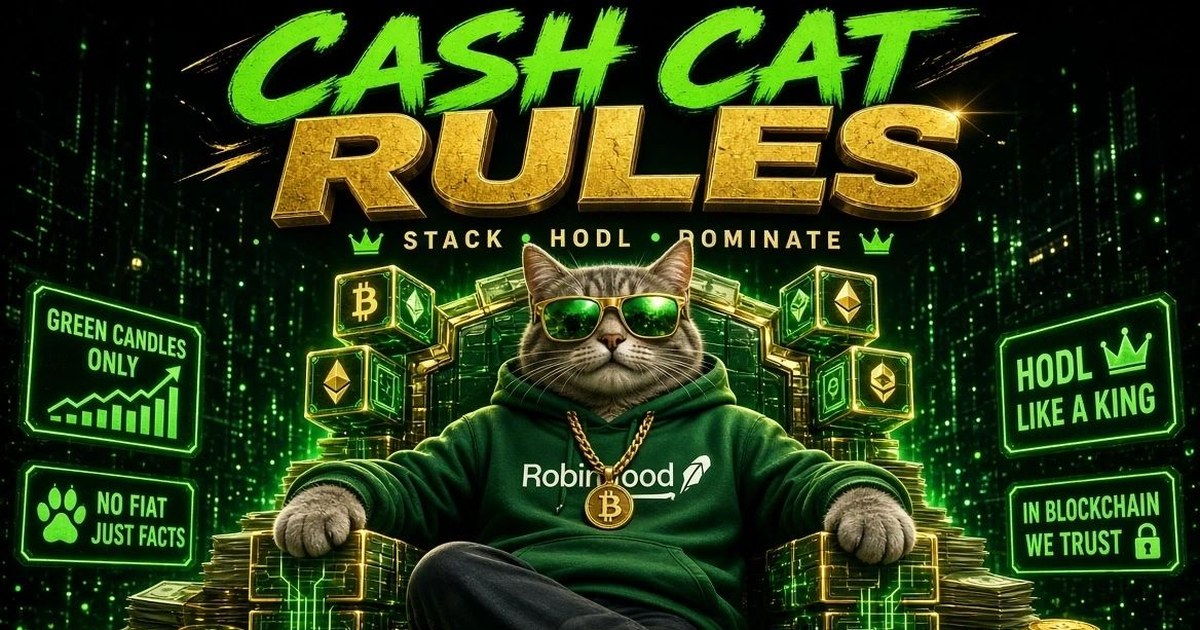
In the early days of what would become one of the most recognizable fintech brands in the United States, the founders of Robinhood considered calling their company Cash Cat. The name was ultimately rejected in favor of the more marketable Robinhood moniker. More than a decade later, that discarded idea has returned with force—not as a brokerage, but as a community-driven memecoin native to Robinhood’s own blockchain.
Launched shortly after the public debut of Robinhood Chain in early July 2026, $CASHCAT quickly became the network’s breakout asset. Built as a simple, zero-tax token with a fixed one-billion supply and burned liquidity, the project positioned itself explicitly as “fan fiction with a ticker.” It carried no official affiliation with Robinhood Markets, a fact its own website repeatedly emphasizes. Yet the cultural resonance proved powerful. Within days the token surged to a peak market capitalization near $200 million, at times accounting for the majority of trading activity on the new Layer-2 network.
The catalyst was a combination of narrative purity and platform dynamics. Robinhood Chain, constructed on Arbitrum technology, opened with the explicit goal of bringing on-chain assets—including tokenized stocks and other real-world assets—to Robinhood’s massive retail user base. When Chief Executive Vlad Tenev publicly noted that the chain “works great for memes too” and followed the token’s account, retail interest accelerated. Trading volume spiked, whale wallets accumulated, and Hyperliquid even listed perpetual futures with leverage. Robinhood itself later added the token to its trading offerings, further amplifying visibility. What distinguishes Cash Cat from the typical memecoin cycle is the unusual alignment of corporate lore and on-chain experimentation.
Most meme tokens rely on pure internet culture or animal imagery. This one leveraged a real piece of company history that had been sitting unused for years. The result was a self-reinforcing loop: the token’s success validated the chain’s capacity for speculative activity, while the chain’s association with a major brokerage lent the token a veneer of legitimacy that pure Solana or Base memes often lack.Market reaction has been characteristically volatile. After peaking, the token corrected sharply as early holders took profits and the initial launchpad that helped fuel the boom faced operational challenges. Still, by mid-August it retained a market capitalization in the low-to-mid nine figures and continued to rank among the most discussed assets in crypto social metrics. On-chain data showed persistent net buying in certain windows and a holder base that expanded rapidly during the initial surge.
The broader implications extend beyond one token. Robinhood Chain’s early experience demonstrates how quickly retail platforms can incubate speculative narratives once they open permissionless environments. It also highlights the tension between institutional product roadmaps—tokenized securities, compliance frameworks, and real-world asset rails—and the chaotic energy of memecoin culture. For Robinhood, the episode has been a mixed but largely positive proof of concept: the chain attracted attention and volume far faster than many expected.Looking ahead, the sustainability of Cash Cat will depend on whether the community can evolve beyond pure speculation. Some holders have already begun discussing Layer-3 experiments that would use the token as gas, while others treat it purely as a cultural artifact. In either case, the episode has cemented a memorable chapter in 2026 crypto history: the company that once rejected the cat now finds itself hosting one of its most successful on-chain expressions.