
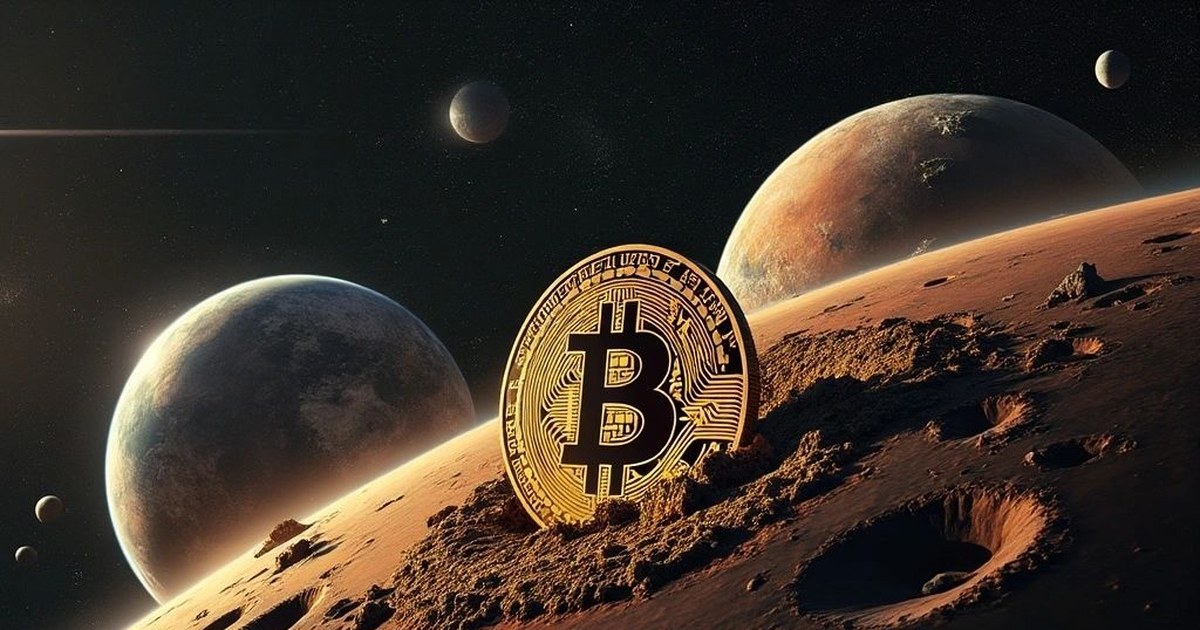
As humanity stands on the cusp of becoming a multiplanetary species, with plans for colonies on Mars and the Moon, the concept of a unified monetary system that transcends planetary boundaries becomes not just a speculative venture but a necessary framework for economic stability. Bitcoin, with its decentralized nature, limited supply, and robust security, emerges as a compelling candidate for this role. Here's how Bitcoin could serve as the monetary base in a multiplanetary civilization:
1. Decentralization and Autonomy
- Interplanetary Autonomy: Bitcoin's lack of a central authority makes it ideal for a scenario where different planetary colonies might have varying governance structures. Each colony could manage its own node but participate in the same network, ensuring financial autonomy without the need for a central oversight from Earth.
- Resistance to Authoritarian Control: Given the potential for new societal structures on Mars or the Moon, Bitcoin's design inherently protects against monetary manipulation by any single entity, safeguarding the economic freedom of these new communities.
2. Store of Value Against Debasement
- Finite Supply: With a cap at 21 million bitcoins, it serves as a digital form of gold, inherently resistant to inflation. In a multiplanetary setting, this scarcity ensures that value isn't diluted over time, crucial for long-term economic planning across planets where resources might vary greatly.
- Digital Scarcity: Unlike physical commodities, Bitcoin can be transmitted through space with minimal cost, making it an efficient medium for trade between Earth, Mars, and the Moon, where transporting physical assets might be prohibitively expensive or logistically challenging.
3. Protection from Global Conflict
- Neutral Currency: Bitcoin operates outside of traditional geopolitical boundaries. In the event of Earth-based conflicts, Bitcoin could remain unaffected, providing a stable financial backbone for off-planet economies. This neutrality could be vital for maintaining economic stability in space colonies during turbulent times on Earth.
- Cyber Security: The blockchain's security model, based on cryptographic principles, offers protection against cyber threats, which could be more prevalent in space where traditional security infrastructures might not exist.
4. Implementation in a Multiplanetary Economy
- Interplanetary Transactions: Bitcoin could facilitate trade not just within planets but between them, using satellite nodes to broadcast transactions. This could lead to an economic mesh network where each colony's economy is interconnected yet self-sufficient.
- Economic Incentives for Space Development: The mining of Bitcoin could be reimagined in space; perhaps using solar power satellites to mine Bitcoin, utilizing space's vast energy resources. This would not only provide an economic incentive for space colonization but also for maintaining the Bitcoin network's integrity.
Challenges and Considerations
- Latency Issues: The speed of light becomes a significant factor in space. Transactions might take longer to confirm, necessitating adaptations in Bitcoin’s protocol or the development of faster interplanetary communication methods.
- Legal and Regulatory Frameworks: Each colony might develop its own regulations around Bitcoin. Harmonizing these laws will be crucial for its widespread adoption.
- Energy Consumption: While Bitcoin mining can be seen as a way to utilize excess renewable energy, in space, where energy might be scarce or expensive to produce, this aspect needs careful management.
Conclusion Bitcoin's potential as a monetary base for a multiplanetary civilization lies in its unique ability to transcend traditional economic constraints. It offers a vision where economic activity can continue unimpeded by planetary boundaries, conflicts, or the debasement of currency through inflation. As we look towards stars, Bitcoin could be the thread that weaves together the economic fabric of our interplanetary future, ensuring that wherever humanity goes, it carries with it a system of value that is as universal as the laws of physics themselves.